The Wright Way

The Wright Way

Thursday, June 8, 2017

Five journeys with my Guide - Part 1

The Odyssey begins ... 

Today was Tuesday in early November 2016. A week ago I was in Cornwall and had driven to Lands End, following a previous day of momentous personal connection working intensively all day with my coach, my Guide.

It all started out as I took a rather circuitous route from Falmouth to Camborne, and then made my way towards St Ives. There was brilliant sunshine and the roads were busy as there were lots of holiday visitors – as this was the schools' autumn half-term week.

Although during the coaching day I had experienced some Insights, light-bulb moments and realisations of clarity, essentially I knew that the greater number of these would begin to arrive after the event.
It is rather like a performance by a sportsperson or a musician, say, when they are in The Zone. It IS where they are in the present, and their consciousness is absorbed and attending to the dimensions of every moment and not attentive to any reflections of deeper meaning or significance for them.
This next day of driving around, I knew, was when the revelations and Insights would really begin to emerge.

Now, before I start, I must tell you that the sleep I had the night before was fitful and agitated. This was in no way due to the comfort of the bed at my overnight accommodation either – it was down to a level of brainwave activity that had begun to build through the evening after the Coaching session had finished. I had sat for about four hours, reading, listening to music and doing a crossword puzzle when I found myself nodding off. So I went to bed drowsy and the moment I turned out the light the endless trains of thoughts began to rattle around in my head. I gave it a good hour in the dark and then put the light back on and finished the crossword.
Now when our volume of thinking is of this magnitude it is very, very easy to get the ‘overwhelm perspective’. Plus the middle of the night can easily be where we examine every thought for clues, and when the answers don’t come we start to question things – and our imagination runs scenarios at first and then finally it runs riot. For me, this was a rare occurrence. For the last eleven years it had been part of my job to help my clients deal with situations like these – not myself. Imagine a dentist trying to treat his own toothache ... and, yes, no it doesn’t work!

But I digress from the story ...

St Ives was stunning and beautiful in the bright sunshine – yet, as I slowly drove past the town’s Park & Ride car park I said to myself – sotto voce – perhaps I should have gone in there. Fifteen minutes later I realised the meaning of ignoring the “nudge from the cosmos” that I’d felt, as I found that it was impossible to park in the town. Everywhere was full!
And thus it was that I drove south out of St Ives, through Zennor, Morvah and St Just, making my way towards Lands End.

I’d never been to Lands End in my life before – so here I was, now, navigating myself into the “Unknown.” It was a journey of physical, metaphorical and psychological discovery. And I was embarking upon this voyage in a state of tiredness, of unsure and unresolved thinking – on the face of it. In the midst of the aftermath of a day of talking, listening, questions and answers, smiling and laughing, eating and drinking and just thoroughly enjoying the company of someone who I hold in the highest regard – I am beset with more questions than answers about where I am, where do I best need to go, if I am going there alone, AND who on earth am I?

By the time I had driven through St Just the mist was rolling in off the Atlantic Ocean and I arrived at Lands End where everything was shrouded under a thick, damp cloak.
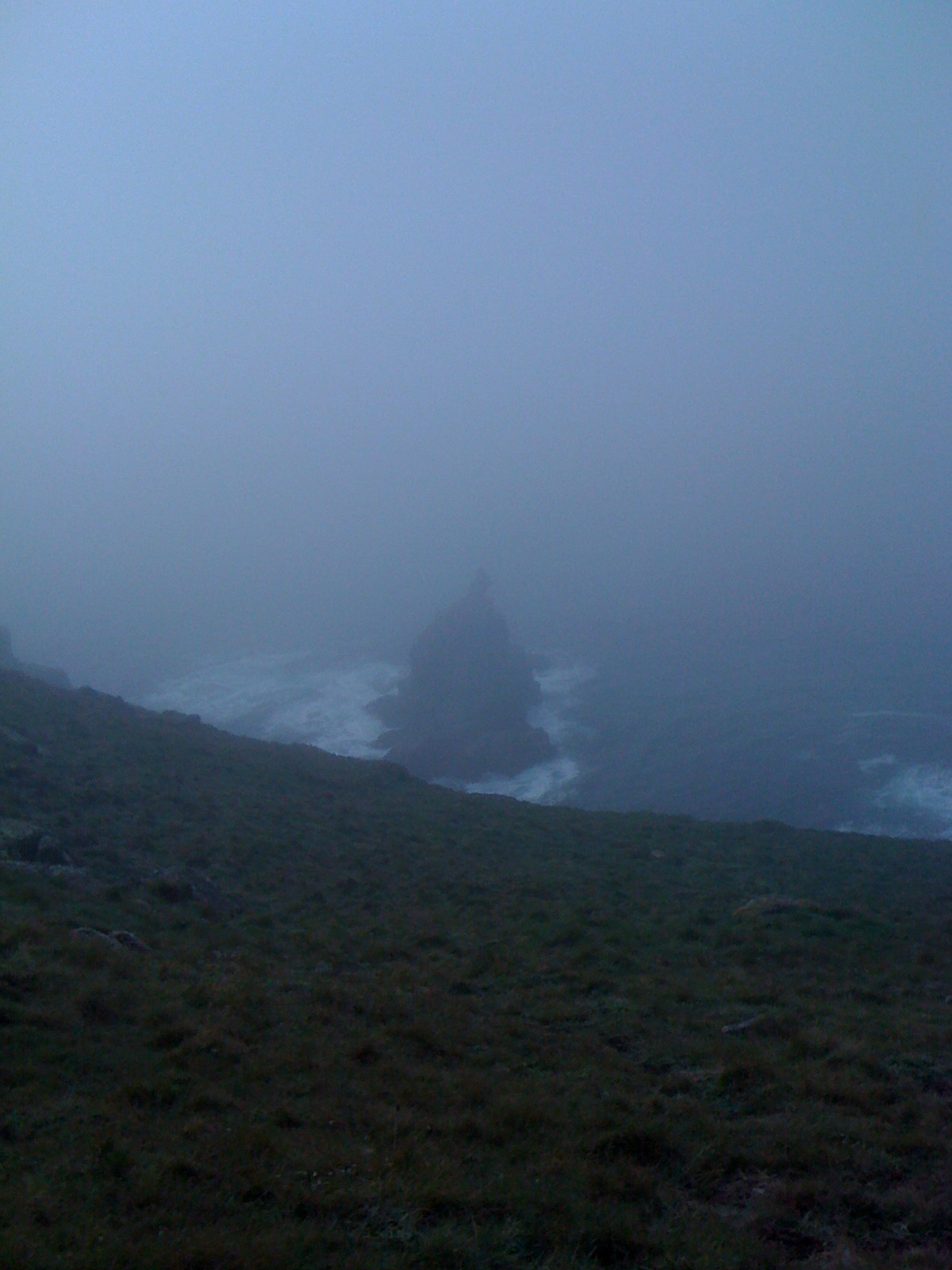


The metaphors of this day, so far, matched completely my state of mind! Yet, my working experiences with metaphor also told me that I needed to park up and walk – rather than quit the whole Lands End experience and come back on a sunny day. There was much to be learned here and I needed to engage and attend.

Curiously enough, as I took a deep breath and “togged up” for a walk, I was reminded of the Beatles song “Blackbird”.

Blackbird singing in the dead of night
Take these broken wings and learn to fly
All your life
You were only waiting for this moment to arise
Blackbird singing in the dead of night
Take these sunken eyes and learn to see
All your life
You were only waiting for this moment to be free
Blackbird fly
Blackbird fly
Into the light of the dark black night


I set out on the coastal footpath to Sennen Cove accompanied by the repetitive sound of the fog horn from Longships Lighthouse. The shapes and sounds of other walkers rose and fell as I made my way along the rocky way, with the engulfing mists swirling all around.

My thoughts at the start of the walk were as confused and uneasy as the physical nature of the land and sea at this point. The unease had been borne aloft by a series of challenging questions by my Guide, at the end of the day before. Questions that got me to examine my needs and my identity. I was unprepared and was unable to give her any cogent answers. 
This was deep – and I, the “me the coach”, couldn’t answer. I could only peer into the abyss.

I took a deep breath – for it always starts with a breath – and I took my broken wings and sunken eyes and stepped into the “Unknown”. And what followed the leap of faith, the trust, was that I sensed the feeling of my hand being in the hand of my Guide. In that moment I was reassured, and I knew every step was safe – though I couldn’t (at that point) have told anyone, including myself, WHY I felt so safe and at home. 

I thought I knew about “following my bliss”, the kind of bliss referred to by Joseph Campbell. 
It was what I had done when I “quit the day job” back in 2005. 
Could this be happening to me, here, again, yet in a context much closer to my core, the inner me?

“If you follow your bliss, you put yourself on a kind of track that has been there all the while, waiting for you, and the life that you ought to be living is the one you are living.”


And then as the path began to drop, a view of
Sennen Cove emerged from the mists.


Saturday, May 27, 2017

Learning Beyond the Learning Curve

Consider the Learning Curve – is it finite, or does it go on ad infinitum? Does the learning flatten out onto a limitless plateau so that we perceive that we can learn no more about this, or that? Or is there another level of learning beyond the learning curve?


Of course, built-in to those questions are some clues as to how we, as humans, think we have arrived at a place of “all-knowledge” on the journey from the place of “no-knowledge.” For when laziness, lack of interest, or even arrogance, overcomes curiosity, then our desire to learn ALL the things there are about this – or that – shuts down.

We think we know it all.

However, we only know more than the fellow next to us, or that chap over there. We can never know all there IS to know about something, for there is a dimension of knowledge beyond the limits of our own perception. To paraphrase the lyrics in the song, “The Circle of Life” -

“There's more to be seen than can ever be seen, more to do than can ever be done” – There’s more to be known than can ever be known, more to learn than can ever be learnt.


The Unconsciousness of Competence


On the “Learning Cycle” we pass from an unaware state of not-knowing, through two other stages, until finally reaching an unaware state of knowing.

Here, now, is where we have the chance to step to the level of Learning Beyond the Learning Curve.
Here is where, in our mental attitude, we either maintain our curiosity and move forward – or where we lose our curiosity, become lazy or indifferent to furthering ourselves, and learn no more.
At this pivotal moment, attitude is everything. It is where that quote by Robert M Pirsig in his book “Zen and the Art of Motorcycle Maintenance” comes into sharp relief.

“Is it hard?”
“Not if you have the right attitude. It’s having the right attitude that’s hard.”

There’s a key thing to know about how we can learn after we reach a state of unconscious competence, which is this:
Because it is unconscious, this means it is out of our awareness. We are not conscious of it. We are learning without knowing we are learning.

But isn’t that what we mean by experience, I hear you say?
Well, perhaps so – yet we can experience many things and learn nothing from experience. To learn from Experience, we need to have that right Attitude that I alluded to earlier.


True Masters

True Masters of any discipline, any course of action, in fact of anything, never accept that they have mastered it. They always aver that there is always more to learn, to discover, to be curious about.

Another key element of True Masters is that they have mastered themselves. They have laid aside their EGO, their SELF IMPORTANCE. This is evident right down to their having the need to know they are still learning. For the part of them, and indeed of us all, that always needs to know, is the EGO.
“Tell me how good I am – I need to know,” it says.

The joy of Learning Beyond the Learning Curve is in those occasional moments of revelation; of discovering that we have just done or accomplished something with effortless action. “How did that happen – how did I know that?” we might say to ourselves. And it is here, at these moments, when we encounter what the Chinese refer to as Wu Wei.

Wu Wei (in Chinese, literally “non-doing”) is an important concept of Taoism and means natural action, or in other words, action that does not involve struggle or excessive effort. Wu Wei is the cultivation of a mental state in which our actions are quite effortlessly in alignment with the flow of life.

In terms of Unconscious Competence, if you consider the phrase “struggle or excessive effort” you can begin to form a link between Mastery and Wu Wei. If we need to, or have to, THINK how to do something, remember something or indeed attempt to undertake any action or task – then this involves excessive effort. Our execution of the task involves not a smooth or easy flow, but a struggle. We have shifted back out of Unconscious Competence into Conscious. The slow, trudging, cognitive conscious that considers and evaluates everything all the way along.
“Getting our head” around something is exactly like that. It is effortful – whereas at effortless, at Wu Wei, our head is clear; there is space.


Learning a Different Way

Another element of Learning Beyond the Learning Curve is one that we might not be quite prepared for. It concerns the WAY we learn.

There are things we find easy to learn, and things we find hard to learn. This is the way of all things and is the way for all of us too. Some things come more naturally to us than others. I would suggest that this is down to the WAY we are learning, or the WAY we are being taught. Of course, when we are being judged, or judging ourselves, in terms of how we are progressing along the Learning Curve of anything – then Competence is what we are being judged on.


Can I do this; do I know this; Can I prove it?

Our level of Competence is down to just three factors –
The WAY we learn, the WAY we’re taught and the WAY we prove.

If only our education system could embody this rather simple equation! Yet, the balance between the first two, makes the third one often seem an irrelevance.
If the way a child learns does not match the way they’re being taught then the Proving will involve struggle and excessive effort. And as we know, starting with SATS and then GCSEs, this entire drama is played out on a regular basis in a child’s life journey through the education system.

Once we reach the point of being on the invisible journey from Unconscious Competence to Mastery, the necessary WAY we learn will change – primarily because the way we are being taught is different.  If we do not accept this, then the journey will be Effortful and will not bear fruit. It is rather akin to what happens to aircraft flying sub-sonic and super-sonic. The forces on the structure as it flies through the medium become altered.

So, if we need to learn a different way because of the different way we are being taught, then a consideration of the way we are being taught is of paramount importance. We need to gain an understanding of the statement:


For me to learn more about this, now, I need to put aside what has got me to this point.

It was this very statement that was my stumbling block when I began my degree in Mathematics. 
Between the ages of 5-18, I had learned everything I knew about maths in one particular pathway of learning. It worked for me, very well for I was more than good at it – I knew all there was to know about MY understanding of maths. The thing was, and I’ve always said this, I did not have an awareness of the paradigm shift between maths the subject and maths the philosophy. If a tutor, or a lecturer, had said at the time, “You are embarking upon a different kind of LEARNING journey,” I would have, I could have GOT it!

To return to The WAY we learn, the WAY we’re taught and the WAY we prove – the paradigm shift reminds me, in the discipline of skiing, of how I went from competent action to effortless action. 

I was in a ski school in an Austrian resort in a group of ten very capable skiers. We were a mixture of nationalities - English, French, German and Swedish; and the Austrian instructor spoke German. The language differences were challenging for him, however he, and we, arrived at a common ground – he tutored us all in French!


Now, here, I was being taught a different way – and not about skiing at all, but only about balance. For a week, I learnt about controlling and shifting balance, nothing else, and in French. Our whole group conversed in French as well – which was a fascinating experience that enhanced the whole new learning process in a most pleasurable way.


It not only changed my way of skiing, but also my learning perspective. And that learning perspective is what has brought me to where I am now in terms of Discovery.


When we realise there are as many ways that we can Learn, as there are ways that we can be Taught, and we apply ourselves with awareness to that, then there is nothing any longer for us to Prove. Our Performance moves from effortful to Effortless.


Sunday, May 21, 2017

Resilience - the Update!

Currently, the buzzword in sporting circles is resilience.
Given a run of poor results or performances, at any given time teams need more of it, whilst some of the individuals within the team have gained a lot more of it, some who had lost theirs have got it back, and some can’t seem to find theirs right now.
Individual players too suffer the same ebb and flow. Everywhere we turn, we hear resilience mentioned.

Because we give it a label, like confidence and charisma, it is immediately more tangible. It is – like a commodity – valuable, tradable, marketable. I know there are, as I write, people in the great wide coaching world away from sport currently billing themselves as Resilience Coaches.

Resilience in performance is described as the ability to remain composed, confident and consistent in the face of errors. A resilient player is one who can let go of errors and return to the present moment.

Back in 2004, courtesy of the Saturday morning Sky TV show Soccer AM, the word “bouncebackability” was coined and it became a bit of a cult word with sports fans, pundits and players. It took a rather sterile phrase from sports psychology - mental resilience in sport - breathed life into it, injected it with pzazz, and gave this six-syllable, concatenated  construction a street cred that almost raised it to being inducted into the linguistic hall of fame called The English Dictionary.

These days, many things to do with the mental side of sport are much more widely mentioned and discussed in the media. Gone is the mystery and we regularly encounter commentators, pundits and players extolling the benefits and virtues of athletes being grounded, of having clarity, of being resilient., of being in a Flow State or in The Zone.

However, as we travel down the players’ spectrum from elite to grass roots we still encounter a lot of the stigma associated with anything tagged with the words mental or psychology. There is still an old-school type of unease and distrust attached to anything referred to as being in the mind rather than in the body.
And it probably goes to the deep-seated fear in our society of being dubbed as a bit of a head case, slightly weird, unhinged, not quite all there, not entirely in control, dysfunctional, having a problem, of being unable to cope, of being ill in the mind, of being – for all intents and purposes – BROKEN.
Our culture, built as it is upon the perfect ideal, can just about put up with broken bodies – but broken minds? Perish the thought. Yet, statistically, we are told that 1 in 4 people in the UK will experience a mental health problem each year.


Bouncing Back

So how can we get to be resilient in our sport – or indeed in our lives?
Can we learn bouncebackability?
The simple answer, of course, is yes.

Why do I say of course? Well, everything starts somewhere and we are not born with an innate understanding of making mistakes and getting over them. We first gain an understanding about making errors and mistakes, of getting things wrong, from our familial culture.
Later, as we first go to school, we discover more about errors, corrections and how society and the others around us judge the making of mistakes.
This early influence lays a very crucial foundation for our ability to be resilient. And when we are growing up and constantly learning things, this ability is with us every waking moment, and pervades every single thing we do.
This underlines my belief that everything, every action, in our lives is a unique performance, and is borne out by this famous quote by Heraclitus of Ephesus:
“No man ever steps into the same river twice, for it’s not the same river and he is not the same man.”

You could say that we are all of us at the mercy of our early influences, so much so that by the time we are seven we have already been put on the road to becoming either a very resilient performer, a confidence player or a perfectionist, or somewhere in between!

However, although this might presuppose that we cannot get off that ROAD once we have been put on it, we are subject to influence and persuasion all the time. And it is the influences we encounter at any time that can steer us elsewhere and to enable us to perform in a different way, and perhaps a more successful or a more fulfilling way.


Gaining a Foothold on Resilience

Once we know there is another ROAD, that we are not doomed or BROKEN, and that there is such a thing called resilience, we can start to discover more about how we can make our performances more consistent and rewarding, and fuse our love of our sport with the joy and ecstasy of doing it to the very best of our abilities, in the moment.
­

Gloria Solomon and Andrea Becker (2004) came up with an interesting acronym that described a four step process they developed to help athletes deal with performance errors.
A.R.S.E

A =
Acknowledge the error and the frustration it has caused
R =
Review the play and determine how and why the error occurred
S =
Strategise a plan to make the necessary corrections for the future
E = Execute and prepare for the next play
Amusingly, they described this as “teaching athletes this sequence will give them a tool for managing the emotional response which comes with making mistakes, and help them to get their ARSE in gear!”


Arseing about

I am coaching an 8 year old at the moment who is very keen on his cricket and has above average talent.
I noticed early on that if he perceived some part of our practice as being a performance, a contest, then his behaviour changed.
He would hit the ball, make a slight error, fall to the ground whilst saying in a miserable tone of voice how he’d got it wrong, messed it up, and seemed inconsolably upset with himself. He appeared to become a near perfectionist and probably had about 5% resilience.
Without consciously realising it at first, I ran the ARSE strategy and got him back on his feet and ready to play the next ball. I got him to hit 10 balls at a target in this little contest, and after every error he ran his sequence and I ran the ARSE strategy.

Now the interesting thing here was that not only was he learning how to be more resilient, but he was also learning about MY coaching culture, and my approach to helping people get over errors and to getting better. By the time we’d moved on to practicing another cricket skill, he’d grasped the whole idea of how we get better at something by making mistakes and getting it wrong.


Work in Progress

I’ve worked with enough perfectionists and confidence players over the years to know that it is definitely a player’s thinking that gets them into a place of low resilience, and that it is definitely their thinking that is getting in the way of their performance.

The Secret – or this particular version of it – is to liberate them from the NEED to Listen to their own Thinking. 
We all have a tendency to hang onto the familiar, and the more familiar we are with Listening to our own Thinking then the more we will hang on to the NEED to do it.

I first used the phrase Work in Progress some years back, with a lad who was inhibited by perfectionism even in practice, let alone in performance. We would be working on some particular skill and his behaviour would change as a result of his (in his eyes) making a mistake – getting it wrong. In a way he resembled my recent 8 year old, in that he struggled with the emotional outpouring initiated by his Inner Judge.
After I explained to him about practice and progress – like that - I watched him listening and nodding, and somewhere inside he made the connection and got his ARSE in gear!
Almost at once he stopped beating himself up in practice. Before the next match he was due to play, I talked with him about how we can take our Work in Progress into a contest. He made mistakes – and he dealt with them well. From that moment on he became a resilient player, and he understood resilience even though we never talked about it.


Conclusion

As a Performance Coach who also works as a technical coach, I consider myself lucky to be in a unique position to be able to embed and interweave one discipline within another. As a result I’m able to raise the resilience of grass roots players without having to tell them that we are going to work on some mental skills. Likewise I’m able to influence an eight year old in terms of resilience, knowing that that growing understanding will help him in other parts of his young life.

I was having a casual chat recently with some sporting folk and someone said,
“Everyone talks about resilience now. Is that like bouncebackability?” I nodded. “Wish I had it.” He continued, “Wish I could get some of that. Of course it’s only for professionals and those at the very top of the game.”
“What makes you think that?” I asked, quite curious about his perspective.
“Well it wouldn’t work on me would it? It’s all to do with what’s going on in here,” he said, tapping the top of his head.

I leaned forward and looked straight at him,
“How do you know you haven’t already got some resilience?” 

Monday, May 15, 2017

What is this thing called Love?

It is a formless construct, an emotional expression isn't it – yet we feel it long before we think it. Now, given that feelings are an expression of our thinking in the moment – where does love come into such correlative equation? Love is beyond thought – surely there can be no other explanation for it!

Well, in order to make things a little bit clearer by degrees, perhaps I should take two perspectives – the temporal and the eternal, and by eternal I mean spiritual. Now, for the purposes of drawing these perspectives, I believe it is best to examine the French philosopher, theologian and cosmologist Pierre Teilhard de Chardin (1881 – 1955).
His most famous quote is probably the one that sets the temporal and eternal apart ~

"We are not human beings having a spiritual experience
we are spiritual beings having a human experience."

This assertion runs parallel with my view that what we do and how we live, love and pursue happiness sits well on such a structure. It explains the concept of Universal Mind as being on a spiritual plane, and supports the notion that every one of our experiences is brought to life through the power of Consciousness, and that the meanings of all of our experiences are interpreted and conveyed to us through the way we harness the power of Thought.

This is the Inside-Out view of reality.
And within that view of reality, Love is very much a spiritual experience, with no harnessing of Thought behind it.

Of course there is, in our modern popular culture in particular, a much more Temporal interpretation of Love – and this is where confusion starts to spread like wildfire. For the things Temporal of Mankind – the day-to-day-ness of humanity shall we say – Love is used as label to mean many more things.
“God Loves You.”
“I love playing football.”
“The child loves her puppy.”
“She loves her boyfriend.”
“Mum, we love you.”
“I love living by the sea.”
These are all different expressions using the same core word, love. Yet the usage is, for want of a better word, lazy. There are many alternatives, other interpretations and synonyms that we could use instead, and if we did then perhaps the word Love would not have been devalued so very much through the 20th century.

Even some dictionaries describe Love as:
Deep affection, fondness, tenderness, warmth, intimacy, attachment, endearment, devotion, adoration, doting, idolisation, worship, passion, ardour, desire, lust, yearning, infatuation, adulation, besotted-ness, etc.
The list of synonyms just grows and grows.

I’ve read elsewhere that it is a friendship that has caught fire. It is quiet understanding, mutual confidence, sharing and forgiving. It is loyalty through good and bad times. It settles for less than perfection and makes allowances for human weaknesses.

Linguistically, Love is both a noun – a love for something, someone -
and a verb –
I love this music, I love that person.

Of course, in the written or spoken word we can take the simple phrase:
“What is this thing called Love?”
And change this phrase around in a number of ways, and for several instances a comma comes in handy also.
What is THIS thing called, Love? Or perhaps:
What IS this thing called love? Maybe even:
What is this thing CALLED, Love?
And so on ...

However – and taking a deep breath here – in truth, the above discourse merely illustrates my point, in that what I really mean about Love is that it is an essential part of our being Spiritual Beings having a human experience. 

To underline this here are a couple more quotes from Pierre Teilhard de Chardin:-

“Love alone is capable of uniting living beings in such a way as to complete and fulfil them, for it alone takes them and joins them by what is deepest in themselves.”

“Love is the affinity which links and draws together the elements of the world ...
Love, in fact, is the agent of universal synthesis.”

And then there are the poets, from whom I will draw just two examples cross the vast panoply of artistic expression. Above all, I would invite you to notice the mention in these two of the Soul. 

The poets, above all, seemed to grasp the notion that deepest, truest Love is eternal rather than temporal; it lies within the Soul; it abides at the level of Spirituality:-


How do I love thee? Let me count the ways. 
I love thee to the depth and breadth and height 
My soul can reach, when feeling out of sight 
For the ends of Being and ideal Grace. 
I love thee to the level of every day's 
Most quiet need, by sun and candlelight. 
I love thee freely, as men strive for Right; 
I love thee purely, as they turn from Praise. 
I love with a passion put to use 
In my old griefs, and with my childhood's faith. 
I love thee with a love I seemed to lose 
With my lost saints, -- I love thee with the breath, 
Smiles, tears, of all my life! -- and, if God choose, 
I shall but love thee better after death.

~ Elisabeth Barrett Browning (1806 – 1861)


How can I keep my soul in me, so that
it doesn't touch your soul? How can I raise
it high enough, past you, to other things?
I would like to shelter it, among remote
lost objects, in some dark and silent place
that doesn't resonate when your depths resound.
Yet everything that touches us, me and you,
takes us together like a violin's bow,
which draws one voice out of two separate strings.
Upon what instrument are we two spanned?
And what musician holds us in his hand?
Oh sweetest song.

~ Rainer Maria Rilke  (1875 – 1926)


The Sufi mystic, Rumi, also had a thing or two to say about Love.


Finally – I would like the last word on Love to be my own.

In the midst of the "Journeys with my Guide", which was an odyssey I experienced through some eight weeks in the autumn of 2016, were episodes of a sometimes inexplicably profound and insightful nature.
I was awakened one night at around 4am by whatever mystery there is to these things – and I felt compelled to write down what had come to mind. I hadn’t spent hours in thoughtful reflection or turned a whole field of thinking over in my mind.
This entire narrative came from Out of the Blue. I wrote concertedly and steadily until I knew I had written all that was there for me to write. Then I returned to sleep for the rest of the night.
The words, which I read the following morning, seemed at first not to be mine but rather had flowed through my consciousness and onto the page.

Love is not a thought that leads to a feeling.
Love IS
Love is not a sense that leads to a sensation
Love IS
Love is not a word that can describe what it is
Love IS
Love is just not what we think it is because
Love IS
Just Love

We are born knowing Love and as we grow we believe that what we are surrounded by is Love – For THAT is what WE are.

Yet if what WE are surrounded by IS NOT Love then we may start to drift away from OURSELVES because we are Love and THIS surrounding us is not Love.

As we go through life having drifted away, we may re-encounter Love and be drawn back towards it – thinking it is just so very familiar though we may never know why, and understand even less so.

Then there comes a day when we see the signpost that points to “Home” – and we might be struck, or see everything bathed in a white light, or hear the summoning clarion call, or hear the softest of whispers louder than thunder. And if we understand and follow the signpost we start to get the real answers to every question about Love we have ever encountered. And every step of the way leads back to Our Selves and back to Love.

And so it is that the truth becomes clearer.
And we may laugh, or we may cry, for it matters not which – we are just back with what IS.

And what IS ... is LOVE.